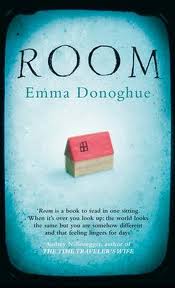
 Room is Jack's story. He's just turned five and lives with his mother in a single room. They are regularly visited by "Old Nick" at night and Jack has to sleep in the wardrobe while he's there. The reader is left to wonder who Nick is and why Jack's mother never takes her child outside, even though - for example - she is desperately in need of dental work. The impression I got was that "Ma", whose real name we never find out, was agoraphobic. It is only later in the book we realise that Jack's mother was abducted at nineteen, that she is now twenty-six and that Jack is her second child by Nick; her first, a daughter, was still born. Despite being related through the eyes of a very young boy and with only two characters in a limited environment, it is a testament to the author that I never once lost interest. The denouement really takes place once Jack and his mother are liberated from the room (and no - I'm not going to give away the details of their escape! You'll have to read the book...) and they both struggle to adapt to the outside world. There is an authorial nod to the intense media interest that follows their appearance but the emphasis is mostly psychological as Jack tries to reconcile himself to "outside", asking his mother "do you ever wish we were still in Room?" while his mother is desperate to put it all behind her and rebuild her life. This is a well thought out, intelligently and sensitively written novel that benefits from the first person narrative of an unusual protagonist whose naivety allows the author to explore difficult topics while maintaining the sympathy of the reader.
Showing posts with label book. Show all posts
Showing posts with label book. Show all posts
Saturday, 8 September 2012
Room
Room is Jack's story. He's just turned five and lives with his mother in a single room. They are regularly visited by "Old Nick" at night and Jack has to sleep in the wardrobe while he's there. The reader is left to wonder who Nick is and why Jack's mother never takes her child outside, even though - for example - she is desperately in need of dental work. The impression I got was that "Ma", whose real name we never find out, was agoraphobic. It is only later in the book we realise that Jack's mother was abducted at nineteen, that she is now twenty-six and that Jack is her second child by Nick; her first, a daughter, was still born. Despite being related through the eyes of a very young boy and with only two characters in a limited environment, it is a testament to the author that I never once lost interest. The denouement really takes place once Jack and his mother are liberated from the room (and no - I'm not going to give away the details of their escape! You'll have to read the book...) and they both struggle to adapt to the outside world. There is an authorial nod to the intense media interest that follows their appearance but the emphasis is mostly psychological as Jack tries to reconcile himself to "outside", asking his mother "do you ever wish we were still in Room?" while his mother is desperate to put it all behind her and rebuild her life. This is a well thought out, intelligently and sensitively written novel that benefits from the first person narrative of an unusual protagonist whose naivety allows the author to explore difficult topics while maintaining the sympathy of the reader. 
Saturday, 1 September 2012
 Can you keep a secret?
Secret Daughter by Shilpi Somaya Gowda follows Kavita, a poor woman who lives in a village outside Mumbai in India with her family. With boys far more desirable children than girls, she is distraught after her first baby - a daughter - is taken away from her and - the reader understands implicitly - killed. So when Kavita falls pregnant again, she prays for a boy. But when her second daughter is born, she is determined that she will not suffer the same fate. Kavita travels to Mumbai when Usha (meaning "dawn") is three days old and leaves her in an orphanage, hoping that she will have a better life. Finally, Kavita has a son, who is named Vijay (which means "victory") and her husband dotes on him, which she quietly resents.
Next the reader is introduced to Somer - a Californian paediatrician who married her college sweetheart, Krishnan, an Indian man whose family is wealthy enough that he could study in America. He and Somer have been inseparable since but are devestated when they learn that she is unable to have children. After much soul-searching, they decide to adopt a baby from India.
 The parallels between Kavita and Somer are evident even at this early stage in the book: both feel that they are not liing up to society's expectations of them - Kavita by having female children; and Somer by being unable conceive at all. When Somer visits Mumbai, she feels even more isolated and uncomfortable, just as Kavita does when she moves to the city.
 Usha - whose name is distorted to Asha (which means "hope" - a lovely word play by the author) also feels like an outsider as she grows up in California, knowing she is adopted and different from her parents.
Determined to follow a journalistic career instead of the medical one her parents want for her, Asha moves to Mumbai for a year to work on a media project and get to know the Indian side of her family better. While there, she starts to appreciate the depth of poverty that exists in the slums of Mumbai and the life her parents saved her from. Although unable to find her birth parents, she learns to be at peace with her background and upbringing.
I thoroughly enjoyed the colourful descriptions of life in Mumbai and Indian culture; never having been, it was fascinating to read about and really inspired an unexpected desire to see it for myself.
The parallels between the women's lives continues although now we see the link between Kavita and Asha instead of Somer as Kavita's mother and Asha's grandfather both die and the reader follows the funeral ceremonies and mourning period of the mother and daughter.
The importance of women to the family unit is emphasised throughout the book - both Jasu, Kavita's husband, and Krishnan are lost without their wives and the longed-for son Vijay, turns out to be a disappointment to both Jasu and Kavita.
I'm not going to give away the ending but it is happily unsensationalist, erring on the side of realism, and all the more moving for that.
Secret Daughter is published by Harper Collins and has sold rights in 22 countries and been a bestseller in USA, Canada, Norway, Israel & Poland. Learn more at http://shilpigowda.com/
Saturday, 18 August 2012
Welcome to the Panopticon
 In a style reminiscent of Irvine Welsh's Trainspotting, The Panopticon is the story of fifteen-year-old Anais. Told through her eyes and in her voice, it takes some getting used to - throughout the book, I found the Scottish dialect ("I dinnae ken") slightly distracting.
 Which was a shame, because Anais' story is a compelling and disturbing one. Having spent her life moving between care homes and foster parents, it is indicative of the unconventional nature of her upbringing that her favourite foster parent to date was Teresa, a prostitute.
When Teresa dies, and Anais is accused of putting a policewoman in a coma, she finds herself in the last chance saloon where troubled young people are sent: the panopticon. Conceived by English philosopher Jeremy Bentham in the late eighteenth century, a panopticon is described as "a circular prison with cells so constructed that the prisoners can be observed at all times" (see image below).
 |
| Jenni Fagan |
Our "heroine" (double-entendre intended) seems permanently high or low on something, which increases her paranoia and she becomes increasingly convinced that she's being watched all the time, even when she's not within the care home. Perhaps the title refers to a mental panopticon as opposed to the physical one? Clearly, the reference was a little too oblique for me.
 |
| Panopticon design |
By turns brutally graphic, at other times poetically insightful, Anais' story always feels tragic. She comes across as a good person let down by the system and one can't help but wonder how many children are out there in the same situation. I can't describe the novel as anything other than depressing and it was hard going plus I still don't really know what was meant by the panopticon. Nonetheless, it feels like an important book to read for anyone who wants to understand despair and it left me grateful that, like Bob Geldof said "Tonight, thank god, it's them instead of you".
Monday, 13 August 2012
 In a Perfect World...
Imagine a world where you can choose your child's attributes before he or she is born. In the fluid, fast-paced and tense Perfect People by Peter James, you no longer have to imagine...
I have commented on previous reviews that there are books I enjoy as stand-alone entities and there are books I enjoy because they make me ponder the bigger questions in life. Happily, Peter James combines the two effortlessly in this thought-provoking and challenging novel that at times, made me proud and at times, ashamed to be human.
John and Naomi only wanted to have a baby free of the genetic abnormality that caused the suffering and early death of their beloved son, Halley. When they are also offered the chance to dictate other features such as appearance, physicality and intelligence to give their their longed-for son the best possible future, they hesitantly accept.
But they end up with more than they bargained for when Naomi gives birth to their son Luke... and his twin sister Phoebe. With exceptional intelligence and capacity for knowledge, but limited emotional and social skills, caring for the twins threatens to push the couple to their limits.
 |
| Peter James |
Struggling to deal with their children, Naomi and John also have to keep a look out for the religious extremists who claim Dr Dettore's murder and are intent on destroying all evidence of his "devil's work" - including the families he created...
Key Questions
If you could eliminate disease, would you?
Similar to the question "if you could go back in time and kill Hitler, would you?", Peter James raises some relevant questions about genetic engineering that are as old as the field-formerly-known-as-eugenics itself; namely, is it ever acceptable, and if so, what are the limits of acceptability? Beyond that, which isn't really explored in the book, the question is: how on earth would one legislate for this? At some point, someone will have to decide...
Naomi and John, who enter into the process in order to eliminate their recessive disease-carrying genes from their offspring, initially baulk at choosing intelligence, eye colour etc (although have no reservations about gender selection). What would your limits be?
Respect for your elders
Luke and Phoebe - with their vastly superior intellect - run rings around their parents and exhibit disdain for them throughout. In a sense, I felt this was an analogy for the parent-child relationship in the twenty-first century. With the explosion of technology, the internet, social media etc, the tools and skills young people need today are very different from those of their parents and even further removed from their grandparents. As a result, many people bemoan the lack of respect for older generations shown by the young. Is this just nostalgia, imagining that they used to show respect for their elders, or is it real? And, like Luke and Phoebe, where does it end?
The nature of love
In ancient Greece, there were four different words for love, each describing a different facet. In their impassive, sometimes condescending way, Phoebe and Luke do seem to love their parents. Naomi, in a more demonstrative, occasionally desperate way, loves her children, while John openly admits he would choose Naomi over the children if necessary. Despite the denouement of the story (which I won't spoil here!) the family come together in the end but I must admit it feels rather passionless to the end and I couldn't work out to what extent this was protagonist utilitarianism (storge to use the ancient Greek equivalent) or real unconditional (agape) love by all parties... maybe I'm just a cynic!
Does science have all the answers?
Another modern position is to assume that science has all the answers, whether we know and understand them yet or not. But as Peter James expertly illustrates in this novel, science can provide the what and the how but cannot (will never?) offer the why (Mallory's retort to the question of why he wanted to climb Everest - "because it's there" - is grossly inadequate and should be to all rational people.)
Ultimately, Perfect People showed me that man has boundless capacity for destruction, manipulation and self-interest. But more than that, as shown in the final pages, we have even greater capacity for love.
Learn more about Peter James at www.peterjames.com/ and his publisher MacMillan (www.macmillan.com). I read Perfect People on my Kobo (www.kobo.com).
Tuesday, 7 August 2012
 Going, Going, Gone!
I read a lot (I may have mentioned this before!) and I've developed a bit of a sixth sense for plot techniques. It's not often that I am surprised by a denouement.I have also read my fair share of books that, frankly, don't deserve the hype: Fifty Shades of Grey, anyone?
But every now and then that rare book comes along that is worthy of the praise heaped upon it and keeps me guessing to the very end.
Gone Girl by Gillian Flynn is one such book.
Nick Dunne and his wife Amy relocate from bustling New York City to small town Missouri when both Nick's aging parents need care. Oh, and because Amy and Nick have run out of money. Although Amy is a trust fund baby, her own parents' financial problems leave the couple unable to sustain their lifestyle - but caring for your in-laws sounds so much better doesn't it?
On their fifth wedding anniversary, Nick arrives home to find Amy gone and the house in disarray. When the police arrive, their investigation reveals that a large amount of blood has been cleaned up in the kitchen and suspicion naturally falls on Nick.
 |
| Gillian Flynn |
Told through Nick's eyes and Amy's diary, this book is packed full of twists and turns for our two protagonists. Is Amy dead? If so, who killed her? If not, where is she? And - as Nick declares his undying love, cynically believing this will bring Amy back - can she return?
In this compulsive, sociopathic game of extreme power play, with life as the ultimate prize, does anyone truly win?
Although it is difficult to warm to any of the characters, who all come across as fairly self-absorbed narcissists, I must confess that I absolutely fell in love with the author, whose warped mind gave me so much pleasure that now, knowing what I do, I have to re-read the book with enlightened eyes to fully appreciate the wit, subtlety and intelligence that went into writing it. Put simply, this is the book that J K Rowling must be desperately hoping she is capable of as her Harry Potter follow-up.
It's no surprise to me that the novel is now to be made into a Hollywood blockbuster (announced on 20 July 2012) by Reese Witherspoon and her production company. I look forward to Flynn's next offering.
Gone Girl by Gillian Flynn is available online, published by Weidenfeld & Nicolson, part of Orion Books.
Thursday, 2 August 2012
 Lest We Forget...
There are books I like because the text itself is innately fascinating, perhaps because of the writing style, the fast-moving denouement, the historical accuracy or its unnerving realism. 
Then there are books I enjoy because they force me to address uncomfortable issues and ask myself questions I would prefer to avoid, but which are key to my own humanity.
A Little Piece of Mother falls into the latter category.
Despite the twee name, there is a challenging premise behind the cutesy-pie exterior: imagine you were liberated from Auschwitz and emigrated to London. You settle with a fellow survivor and have a family. A few years later, a German family move in next door...
The Kalinskis are Polish Jews who emigrated to London in the aftermath World War Two. Psychologically unable to deal with the horrors she experienced in Auschwitz, Martina's mother will not allow any discussion on the topic.
 |
| Barbara Towell |
When the Wilners, a German family, move in next door, Martina's wish is granted in the worst possible way as her mother's mental health - always fragile - drastically deteriorates and she accuses Mr Wilner of being an Obersturmfuehrer, poisons his dog and sets fire to his shed.
Cleverly juxtaposing the agony of unimaginable horror revisited with the banal minutiae of Martina and her friends' teenage angst ("Why hasn't he called yet? wails Krysia"), I was by turn totally out of my comfort zone and then thrust back into the wilderness of my own teenage years.
I ultimately felt that this novel did not satisfactorily deal with holocaust survival, depression, post-traumatic stress disorder, anti-Semitism and the other key issues touched on in the book, which was a bit of a disappointment.
But, in all fairness, who has managed to resolve these issues? No one I know.
Throughout the book, I was constantly asking myself: what would I do? To which there is, of course, no answer. Thankfully, I have not been in that situation. And hopefully, I never will be. But in the spirit of the Ode of Remembrance, I commend Towell for attempting such a difficult subject "lest we forget".
Published by Author House (@authorhouse), A Little Piece of Mother is now available on Amazon for the first time.
Tuesday, 24 July 2012
Last Light and Afterlight by Alex Scarrow
 Do you know what peak oil is? Me neither - until I read these books by Alex Scarrow. Author of the ubiquitous TimeRider series, in Last Light and its sequel Afterlight, Alex explores the serious question: what happens when the oil runs out?
 In true Scarrow style, however, this is not a thesis on consumerism or a dissertation on the technological age. It is a fast-paced, thought-provoking roadmap through suspicion, fear and outright terror as society quickly breaks down.
Using a narrative tool to fast track the denouement of Last Light, Alex Scarrow imagines that all oil production is unexpectedly halted simultaneously around the world. Unlikely, granted; but once you set aside your healthy scepticism and run with it, the implications are shocking. Suddenly armed forces overseas may be stuck there with the enemy because we cannot bring them home; there is no electricity, running water, heating or power in our homes; stores quickly run out of food and water as the supply chain breaks down and hoarding begins (and think how little the UK produces in terms of agriculture etc today...); there is no fuel for private or public transportation so people stuck far from home must take chances and walk; law and order breaks down as the police and other key personnel rush to be with their loved ones. In short, in takes just one week for chaos to reign.
 |
| Alex Scarrow |
In the midst of this, we follow the members of one family as they struggle survive and find one another in unimaginably difficult circumstances. And then there's the shadowy figures hunting one of them, because she may know who has masterminded the chain of events.
 Scarrow, recognising the inherent challenges in moving the story on, deftly avoids them by setting the sequel Afterlight some years later. Not all the family members have survived but those who remain have joined up with other survivors and are now living on a defunct oil rig in the North Sea, isolated, self-sufficient and safe. But just as a mysterious, attractive foreigner shows up in suspicious circumstances, the leader of the group has an accident that renders her too ill to function, leaving a gap that the newest member is only too happy to fill. Meanwhile, some of the young adults in the group are convinced that, somewhere on the mainland, life as they only just remember it must have re-started and three of them set out to find a place where there is electricity, junk food and video games. Instead, they find a world of cannibalism, child soldiers and a ruthless dictator, running out of supplies, intent on invading their oil rig.
 Although I feel that Alex Scarrow does chicken out somewhat by relocating the sequel a few years ahead - we never learn how the family met with the others in the group, let alone how they found and colonised an oil rig - I find his explanation (that the novel would be more logistical than narrative) reasonable. What disappointed me more was that we never learn who was behind the halt in oil production, what they hoped to achieve and what happened to them. What I did appreciate, however, was that - unlike some sequential novels - both books were independently outstanding. Reading them both in order obviously improved the reader experience but they could also stand alone.
In addition, the subjects touched on in the novels are not easily forgotten: from our dependence on oil, to whether what we value as a society are the right things, to the resilience of the human condition in the face of adversity and the desire of some elements of society to dominate at the expense of others.
In a sense, these books hold up a mirror to society and shows us the best and the worst of ourselves. Thought-provoking, insightful and well-written, these novels may also be prescient. We just have to hope they are not. For an easy read that intelligently uses a light touch to depict some key topical and eternal questions, you cannot do better than Alex Scarrow's Last Light and Afterlight.
Learn more about Alex Scarrow at http://www.scarrow.co.uk/ or follow him on twitter (@alexscarrow). I read these books on my kobo (www.kobobooks.com)
Thursday, 19 July 2012
Shot of Tequila by J A Konrath
 Set in the early 1990's, Shot of Tequila is a witty, self-effacing and fast-paced thriller full of twists and turns. Our hero, the eponymous Tequila Abernathy, is a former gymnast who works for the mob as a debt collector, which he justifies to himself because it enables him to pay for live-in care for his older sister who has Down's Syndrome.
But his world is turned upside down when he is accused of stealing $1,000,000 from his boss, Marty the Maniac. Tequila knows he's been framed and sets out to prove it. Dead bodies follow him around and as a result, as well as avoiding his former colleagues, he also needs to hide from the police, including our policewoman heroine, Jack (Jacqueline) Daniels.
Shot of Tequila is the best form of escapist reading I know: it's so outlandish and outrageous that I can confidently sink into it, understanding from page one what kind of story I'm reading. The author clearly knows this and as a consequence, the book doesn't take itself too seriously; that would have been the death knell for this crime/humour/thriller genre. But the author's light touch and insightful sense of entertainment ensures that the reader is gripped but not weighed down by the novel.
I am a voracious reader and not particularly fascinated by any single genre: I flit from historical fiction to science fantasy and psychological thrillers. What draws me in is the writing style of the author. I adore authors who (apparently) effortlessly inhabit their characters and make me believe - and like - them, even when they are ostensibly unlikeable.
Could the book have explored the challenges of living with Down's Syndrome? Could it have lamented the lack of career opportunities for retired gymnasts? Could it have moralised about the risks of borrowing money from loan sharks?
Yes of course it could. But that was never the intent. One almost feels that the book was simply an avenue for the author to share his own effervescence with us.
And thank god he did.
Learn more about J A Konrath and his other novels at http://www.jakonrath.com/ or follow him on twitter @jakonrath. I read this book on my kobo (www.kobobooks.com)
Saturday, 14 July 2012
 Predictably Irrational
Have you ever wanted to better understand your colleagues, customers, family and friends? Or even - dare you admit it - yourself? Subtitled "The Hidden Forces that Shape our Decisions", Predictably Irrational is a work by behavioural economics professor Dan Ariely. Despite his impressive and somewhat intimidating resume, which includes MIT and Princeton, Dan's writing style is chatty and easy to follow.
 |
| Andrew Lloyd Gordon |
And what a revelation! Although Dan Ariely's field is behavioural economics, there's a strong psychological resonance to his work as well.
Addressing questions like "why does recalling the ten commandments reduce our tendency to lie - even when we KNOW we can't get caught?" and "why do headaches persist after taking a cheap painkiller but disappear when we take an expensive one?", the book explores the idea that, in the modern age, we believe we are enlightened, rational beings in control of our own lives (Nietzsche and Richard Dawkins anyone?).
But are we? From choosing to pay £3+ for a cup of coffee to the obesity epidemic and choosing a romantic partner, we are consistently willing to overpay, underestimate and procrastinate. We fail to reconcile the impact of our emotional responses with our choices. Dan Ariely systematically analyses our decision-making process and reveals the pervasive and predictable irrationality that informs it.
 |
| Dan Ariely |
Let me share one example of the kind of question that Dan examines: suppose you go around to your mother-in-law's house for dinner. You have a good time. At the end, you pull out your wallet and say "Pam, I had such a great evening. What do I owe you?" Silence falls. You open your wallet and say "Would $300 cover it?" No one says a word and your wife looks daggers at you.
Now let's rework that scenario: suppose you go around to your mother-in-law's house for dinner. You give her the $10 bottle of wine as you enter the house. She thanks you warmly and leads you inside.

Think about this on a rational level: why would your greater gift be offensive? Surely it shows a greater appreciation for her hosting of the evening? But we all know that it would not be perceived that way. And we all know this; ergo, it is predictably irrational.
Described by the Financial Times as "unmissable", this work, published by Harper Collins, is accessible but powerful and will make you look at your life and your choices in a new way. Please, please read it.
Learn more about Dan Ariely at www.danariely.com, the IDM at www.theidm.com and Andrew Lloyd Gordon at www.andrewlloydgordon.co.uk. Harper Collins can be found at www.harpercollins.co.uk and the Financial Times at www.ft.com
Saturday, 7 July 2012
Grey is not my favourite colour...
 50 Shades of Grey has become an international phenomenon. For those of you who have been living on a different planet, it follows the relationship of about-to-graduate college student Anastacia "call me Ana" and Christian Grey, a billionaire who she meets when she interviews for the college magazine.
 An inexperienced, shy virgin, Ana is overwhelmed by his intense wooing of her, laced from their first meeting with sexual tension and innuendo.
In graphic (bordering pornographic) detail, the book traces our protagonist's first ever relationship, featuring from an unfeasibly early stage, his "red room of pain and pleasure" in which Christian, as a Dominant, wishes to spend much of his time with Ana.
Shock, horror! Our gauche young college student realises she has a taste for her controlling and emotionally distant lover and, unlikely as it seems, he feels the same and they fall in love. The book follows their struggle to identify compatability: Ana wants more of a traditional relationship with Grey, while he wants to dictate all aspects of their relationship and expects complete obedience. Both of them make compromises, but is it enough? Can they work out their differences? At the end of the book, which is dominated by explicit descriptions of their sex life, Ana breaks it off with Christian, believing they cannot fully satisfy each others' needs. Cue the next book in the trilogy...
So did I enjoy 50 Shades of Grey? Well, yes, I have to admit I did,. Did I find it compelling, believable and worthy of the hype it has generated? No way.
I have several issues with this book.
Use of sterotypes
Why does it have to be the man who is the dominant one? Why oh why can we not see a woman take charge and set the tone? Did the author really need to pander to pornographic references "ooh the innocent school girl" and "ooh the naughty older man". Oh please. This is the 21st century. I found this quite cringe-worthy. And before you retort "But Christian had a relationship with an older woman before he met Ana" - I know this. But let me point out that she is repeatedly referred to as a paedophile and an abuser, with fairly weak denials. Double standards? Not so enlightened.
Unbelieveable
Aside from the unlikeliness of Christian Grey and Ana ever meeting in the first place, would a billionaire playboy really be that interested in Ana? Yes she bites her lip, which he apparently finds irrestible, but I just didn't see enough in her to warrant his stalker-like focus on her. What does she bring to the table, really? She isn't the worldly, submissive he desires. Would he want to spend so much time on her "training"? And would he really present her with a legal contract and and NDA? How disappointingly modern.Lack of originality
The Secretary anyone? How about 9 1/2 Weeks? Or innumerable Black Lace books? The only original thing this book has done - as far as I'm aware - is to successfully cross-over from the 18+, soft porn category into the mainstream, making BDSM more accessible to everyone. And I'm not sure that's such a good thing. Would you want your 13-year-old daughter to read this book?Dominant vs. Sadist
Despite Christian Grey's insistence that he is a dominant, not a sadist, I couldn't really tell the difference. He gets off on doling out pain as well as dominating, so surely he's both? The issue is raether that Ana is neither submissive nor a masochist.Character likeability
 Be honest. Did you really warm to either Christian or Ana? Christian, our "hero" is a billionaire playboy who admits to having paid for sex in the past, continually and patronisingly calls her "baby" and flaunts his wealth as much as possible. The half-hearted attempts to make him vulnerable are too obtuse for me. Ana is inconstant - sometimes pathetic, sometimes bolshy, always over-analytical and dull. Think about it: outside of her relationship of Christian, what is interesting about her?
In summary, to my mind, this book panders to the female fantasy - a complicated, wealthy man who cares about you and is willing to change to please you. In reality, you would drive each other mad, irritate each other no end and realise pretty quickly that you are incompatible sexually, emotionally, financially and with regard to background, ambition, future plans - basically in every way.
But this is a book designed to titillate. It does that. And perhaps that's enough.
Monday, 2 July 2012
Review of Trafficked by Sophie Hayes
I really had to post a review of this book which is an unequalled example of triumph over adversity and of finding inspiration through tragedy.
 By way of introduction, we learn that Sophie comes from a middle-class family. She has never felt good enough for her father, who was abusive to her mother, her brother and Sophie herself before her parents separated. She achieved good grades throughout school, although she opted not to go to university. Her first love was deported back to home country and while she dithers about whether or not to marry him so that he can return to England with her, fate takes the decision out of her hands as she is admitted to hospital and is unable even to let him know what has happened. When she recovers, the window of opportunity has passed.
I really had to post a review of this book which is an unequalled example of triumph over adversity and of finding inspiration through tragedy.
She reconnects online with a good friend she met several years earlier who has since moved abroad. When he invites her to meet him in Paris, she does not hesitate and has a wonderful time. So, when he next invites her to meet him in Italy, she looks forward to it. But this is where her nightmare begins.
Shortly after her arrival in Italy, she is told that her friend owes thousands to drug lords and then she must "work off the debt". Forced into prostitution by someone she trusted, who now threatens her and her family back in England if she doesn't comply, she is psychologically tortured, mentally beaten and physically abused. Told that the police are in his pocket and with him monitoring her phone calls to her family, she has nowhere to turn.
I won't ruin the denouement by describing how she escapes - nor what happens next (let's just say her nightmare is not over even after she is reunited with her family). I do nonetheless want to reassure readers that her story ends on a high note that truly demonstrates that love can triumph over the odds and that the human spirit is more resilient than we can ever comprehend. Sophie is without question one of the strongest and the truly "good" people in this world; even if, to the end, you don't feel that she believes it.
And it is arguably this which makes the book so readable: even in the depths of despair, Sophie is undeniably engaging yet self-deprecating, introspective but realistic, managing to share the details of her ordeal in a way that touches your soul without dragging you down. A fine line to walk but achieved with a mixture of finesse and innocence that makes you want to cry when you think of everything she went through, and how she emerged a sensitive, caring young woman determined to improve the world for other people.
Learn more www.sophiehayesfoundation.org/
Wednesday, 27 June 2012
Review of Death Bed by Leigh Russell
I must say: I've been a bit of a fan of Leigh Russell for a few years and the blurb on Amazon really says it all: after she burst onto the crime thriller scene with Cut Short in 2009, which was shortlisted for the CWA New Blood Dagger Award for Best First Novel, Leigh Russell has gone from strength to strength. Her follow-up novel Road Closed was published in 2010 and also featured the policewoman heroine Geraldine Steel. Leigh Russell continued the series with Dead End in 2011 and Geraldine Steel became the number one bestelling female sleuth on Amazon Kindle. As a result, I couldn't resist reviewing Death Bed, the fourth in the Geraldine Steel series, which was released recently, also published by No Exit Press.
With Geraldine still seemingly unlucky in love - there's still no man on the horizon - and her relationship with her sister still awkward after she learned she was adopted, she buckles down to work, hunting for an apparent serial killer with a gruesome fetish.
Set in London with scenic descriptions that evidence the painstaking research of a literary perfectionist, Death Bed starts with the abduction of a girl who's just been out for a night with her friends and is a little the worse for wear. So far, so good - especially when you think about the number of times you've been in that position yourself... and the man who offers to take her home shows her his police identity badge so surely she's safe to accept... But is he really a policeman? And even if he is, does that make him exempt from evil? And more significantly, is it possible to live forever?
An innovative and refreshing take on the psychological thriller, with a strong female heroine who is struggling - just like everyone else - to balance her work and her personal life and muddle through, knowing all the time that every decision she makes could mean life or death.
Learn more about Leigh Russell at www.leighrussell.co.uk or at www.youtube.com/leighrussellauthor
Tuesday, 19 June 2012
Review of Divergent and Insurgent by Veronica Roth
 I recently read two books by Veronica Roth. The first is Divergent, the sequel of which is called Insurgent. I thoroughly enjoyed both these books and a third is planned for release in late 2013. They are fast-paced, full of dilemnas and decisions under pressure and feature twists and turns at almost every page while making sure the reader remains gripped. Reminiscent of The Hunger Games trilogy, this collection is surely also due to be a modern classic.
Divergent is set in a future where everyone grows up as a member of one of five "factions" or communities:
Amity - where people value friendliness
Dauntless - where people value courage
Erudite - where people value knowledge
Candor - where people value honesty
Abnegation - where people value selflessness
Together, the senior members of these factions govern the whole society and viewed by its members as balancing each other out perfectly.
When teenagers finish school, they take an aptitude test to determine which faction most suits them and they then have to choose whether to stay in the faction where their parents are and where they have spent their whole life so far, or whether to move to a new faction, about which they know only stereotypes and generalisations.
The story follows Beatrice Prior, whose aptitude test reveals that she is actually a sixth "type" known as Divergent. This means that she has more than dominant trait and would fit in well in a number of factions. However, Divergents are feared because they could upset the natural balance of this faction-ed society, and are thrown outside the city walls when they are found. She is able to conceal her divergence and chooses to move from Abnegation to Dauntless, to the shock of her family, and changes her name to Triss.
The Dauntless initiation tests are harsh and push her to her mental and physical limits. Anyone who fails is out and becomes factionless, which is seen as a fate worse than death.
She also falls in love with Four, another Dauntless member with a mysterious past...
 Just as she's starting to settle in to her new life, one of the factions stages a coup to take over the government of the whole society in the most horrific way, throwing Triss' personal loyalties and feelings into question as she struggles to work out who she can trust and what she should do.
Insurgent picks up the story where Divergent left off - literally - so I have to stress that you need to read these in order or I don't think you will be able to follow. A lot of the situational detail is provided in the first book, and the second assumes that you already know some of the terminology and does not explain it again. For this reason, I also recommend that you read them both in quick succession, so that the information is all fresh in your mind.
Key Questions
Utopian or Dystopian?I am still struggling with the question of whether these books are intended to describe a dystopian or utopian future. On the one hand, a society where everyone has and knows their place may be a wonderful thing. There would - theoretically - be a perfect balance of inputs and outputs based on aptitude, ability and needs. On the other hand, that's almost a communist ideal and we have seen in real life that that doesn't work. I think the author's perspective is that this is dystopian because such a balance between different factions cannot be maintained - initially it seems that one egomaniacal faction leader has gone insane and that this is the cause of the war, but at the end of Insurgent (the second book) we learn that there may have been good reason.
Does the means justify the end?
During the course of these books, our heroine - and she is clearly a heroine, albeit a troubled one (but doesn't that just make her more interesting?!) - has to act in ways that she sometimes questions: she lies, she kills people, she hurts those who love her. But she always justifies it to herself and therefore, to us, the readers. Whether we accept her explanation or not is another matter.
What would I be?
As a fun aside, I gave a little thought to which faction I would likely end up in. I think I'd probably be Erudite - and I mean that in the best possible way. You'll have to read the books to know what means!
Which faction do you think you would be?
Subscribe to:
Posts (Atom)